

Renault Key Card Not Working or Not Detected?
Quick answer — A Renault key card that won't unlock or start the car is almost always caused by a flat coin-cell battery — CR2025 on older cards, CR2032 on newer ones, lasting about two to four years. Replace the battery first; if a known-good spare card also fails, the fault is inside the card's electronics and the card itself needs replacing, not the car.
Why your Renault key card stops working (and shows "Card not detected")
In the vast majority of cases the card has simply run out of power. The coin-cell battery inside is the card's only energy source, and once it weakens the card loses range, then stops locking and unlocking, and finally fails to be recognised inside the cabin — usually shown as a "Card not detected" or low-card-battery warning on the dash. Genuine electronic faults exist, but they are the exception, not the rule.
Every fault traces back to one of three places: the card (battery or damaged electronics), the signal path between card and car (interference), or — rarely — the car's own card reader or antenna. Work through them cheapest-first and you avoid buying a part you didn't need.
| Symptom | Most likely cause | First thing to do |
|---|---|---|
| Card works only at very short range, or after several presses | Weak battery | Fit a fresh coin cell |
| "Card not detected" / car won't start, buttons dead | Flat battery or cracked board | New battery, then inspect for cracks |
| Works intermittently, fine some days | Signal interference or a tired contact | Move phone/second key away; clean contacts |
| Nothing at all, even with a new battery | Damaged transponder, or car reader fault | Test your spare card |
The battery: which one, and how long it lasts
Renault cards use a single 3-volt lithium coin cell, but not the same one across the range. Classic cards from the Mégane II, Scénic II, Laguna II and Espace IV era typically take a CR2025; most newer card-style and Keyless Go remotes take a CR2032. The two are the same diameter but different thicknesses, so the only reliable method is to split the card open and match the code printed on the old cell rather than guess by model. A card battery lasts roughly two to four years, and hands-free cards drain faster because the car is constantly querying them.
The one test that saves you money — Try your spare card. If the spare unlocks and starts the car perfectly, the fault is 100% inside your main card — not the immobiliser, reader or wiring — and a new card will fix it. If both cards behave the same way, look harder at the car.
Five-minute fixes to try first
Most "dead" Renault cards are brought back to life in minutes with no replacement at all. Run these checks in order before you assume the card is finished.
- Replace the coin-cell battery — Release the emergency blade, prise the card open along the seam, note the printed code (CR2025 or CR2032), and fit a fresh, branded cell the same way round. This alone fixes the clear majority of cases.
- Remove signal interference — Move your phone, a second key fob, or anything metal away from the card and try again. Two transponders touching in the same pocket can confuse the car's receivers.
- Clean the internal contacts — If a new battery is intermittent, lightly clean the battery terminals and chip contacts inside the card with a dry cloth or isopropyl alcohol. Corrosion and damp are common after a card has been sat on or rained on.
- Use the emergency blade and slot reader — Locked out or won't start hands-free? Pull the metal blade from the card to open the door, and on cards with a dashboard slot, insert the card into the reader to start. This bypasses a weak hands-free signal.
- Re-sync the card — After a flat battery some cards need re-pairing to the car. The procedure varies by model, but a card that lights up and clicks yet won't operate the locks is often just out of sync — an auto locksmith can re-sync it in minutes.
When the quick fixes won't help — If the card is visibly cracked, has been through water, or has snapped, no battery or re-sync will save it — go straight to a replacement. The same is true if you have lost every card: there is nothing left to repair.
When the card needs replacing, not the car
Replace the card — not anything on the car — whenever a known-good spare works but your card doesn't, or when the casing shows damage that has reached the electronics. A cracked board, a water-soaked chip or a snapped card cannot be trusted to authenticate reliably again, and a card that only works "sometimes" will eventually leave you stranded.
- Visible cracks — A hairline fracture can sever the antenna loop or transponder track inside, causing total or intermittent failure.
- Water damage — Once moisture reaches the board, corrosion spreads. Even if it works today, it is living on borrowed time.
- Snapped or bent — A card flexed out of shape cannot be reliably repaired. Replace it rather than gamble on a roadside failure.
- Spare works, yours doesn't — The definitive sign the fault is in the card. A new card programmed to your car restores full function.
You cannot reuse a second-hand Renault card — Once a card is coded to a vehicle, its chip is permanently locked to that car's immobiliser. A used card from a breaker or another vehicle will never program to yours — so a new, unprogrammed card is the only route. It is a security feature, not a sales pitch.

Which Renault card or remote you need
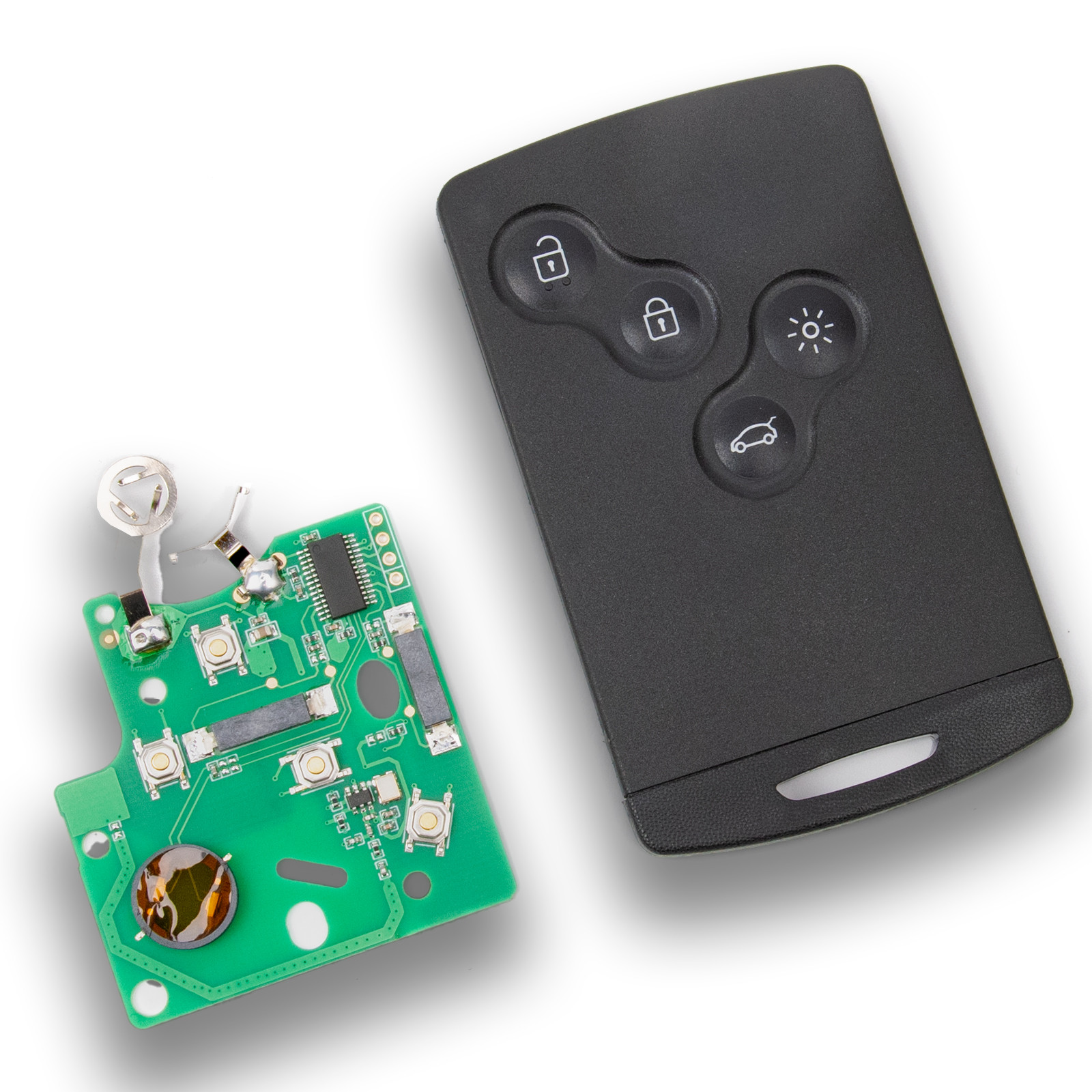
Match the replacement by its transponder chip and frequency, not by model name alone — Renault used several card and remote designs across overlapping years and markets, so the same car can take more than one part. The reliable identifiers are printed on the old electronics: the chip number (for example ID46 PCF7947 or 4A HITAG AES PCF7961M), the frequency (433 or 434 MHz), and the OEM part number, often moulded into the back of the board.
Renault uses three distinct key formats, and knowing which you have narrows the choice immediately: the hands-free key card (carte mains libres — no buttons needed, used on Laguna, Espace, Mégane and Scénic), the insert key card (slotted into a dashboard reader to start), and the flip remote key (a conventional button fob with a fold-out blade, common on Clio, Twingo, Kangoo and Master).
| Model & era | Key format | Chip | Freq. | Example OEM |
|---|---|---|---|---|
| Mégane II · Scénic II · Laguna II · Espace IV · Vel Satis (2002–2009) | Insert key card (slot-in) | ID46 PCF7947 | 433/434 MHz | 7701209129 |
| Laguna III · Mégane III · Scénic III (2008–2015) | Hands-free keyless card | ID46 PCF7952 | 434 MHz | Key Smart Card (PCF7952) |
| Clio III · Modus · Kangoo II · Twingo II · Master (2005–2012) | Flip remote | ID46 PCF7961 / PCF7974 | 433/434 MHz | 7701210033 · 8200100173 |
| Clio IV · Captur · Symbol · Twingo III · Dacia Duster (2012–2019) | Smart remote / card | 4A HITAG AES PCF7961M | 433/434 MHz | 805670077R · 805673071R |
| Mégane IV · Talisman · Espace V · Kadjar (2015–2023) | Hands-free Keyless Go card | 4A HITAG AES | 434 MHz | Megane 4 Keyless Go |
| Trafic III · (Nissan-based) Kadjar / Juke | Remote key | ID46 PCF7946 / PCF7952 | 433 MHz | 285E31KA0A |
How to find your exact part number
Open the card and read the chip and OEM numbers off the board, or photograph the back of your old card and the metal blade. If the electronics are unreadable, the dealer's parts system can identify the correct card from your VIN and the Renault oval plate inside the driver's door opening. For the hands-free keyless-go card, our Renault Laguna / Mégane keyless smart card (434 MHz, ID46 PCF7952) and the newer Mégane IV / Dacia Duster keyless smart card (4A HITAG AES) are direct OEM-spec matches — useful reference points for what to look for on your own card.
Ordering a replacement: what to send, what to expect
An aftermarket Renault card or remote costs roughly €15–€30 and ships blank — that is the single most important thing to understand before you buy. The part is correct-spec hardware, but it is not plug-and-play: the emergency blade must be cut to your key code, and the transponder must be programmed to your car's immobiliser, before the card will open or start the vehicle. Budget for a short local appointment, and you still pay a fraction of a main-dealer price.
What to have ready before you order
- Chip & part number — Read from the old board or matched from your VIN — this picks the exact card.
- Key code — Stamped on the original key or door lock. Needed only if you want the blade cut to your locks.
- A photo of the old card — Front, back and blade. Lets us confirm the format before dispatch.
- VIN — For all-keys-lost programming, the locksmith reads the immobiliser PIN from it.
What we do — and what your locksmith does — We supply the correct OEM-spec card or remote and can cut the emergency blade to your key code before dispatch. Programming the transponder to your car is done locally by any auto locksmith or dealer with Renault diagnostic equipment — adding a card when you already have a working one is quick and cheap; an all-keys-lost job needs the immobiliser PIN and takes a little longer.
If every card is lost, treat security as part of the job: programming a new card should also delete the old, lost cards from the car so a found or stolen card can no longer start it — the same principle behind official UK police guidance on keyless vehicle security, which also recommends reprogramming keys whenever you buy a used car. We dispatch across the EU from Germany, so order the correct card now and have it ready for your programming appointment.
Frequently Asked Questions
Will a replacement Renault card arrive ready to use, or does it need programming? It needs programming. An aftermarket Renault card ships blank — its emergency blade must be cut to your key code and its transponder programmed to your car's immobiliser by a locksmith or dealer before it will unlock or start the vehicle.
Can I order a Renault key card without my key code? Yes. You can order the card without a code, but the emergency blade arrives uncut; to have it cut to your locks, supply the key code from your original key or door lock, or send a clear photo of the old card.
Can I program a used or second-hand Renault key card to my car? No. Once a Renault card is paired to a vehicle's immobiliser it is permanently locked to that car and cannot be transferred. Only a new, unprogrammed card can be coded to your Renault — a deliberate anti-theft measure.
What if I've lost all of my Renault key cards? An 'all keys lost' job still works, but it is more involved: a locksmith or dealer reads the immobiliser PIN from your VIN, then codes a brand-new card from scratch. Order the correct blank card, then book a local programming appointment.
How much does a replacement Renault key card cost compared with a dealer? An aftermarket Renault card or remote costs roughly €15–€30 from mr-key.com, versus well over €100 at a main dealer for the part alone. You then pay a local locksmith only for cutting and programming.
Found the right card? Order it in minutes
OEM-spec Renault cards and remotes for every model and era — hands-free cards, insert cards and flip remotes — dispatched across the EU, with optional blade cutting to your key code.
Browse our collection of Renault keys & cards →
Browse our collection of Renault keys U cards without electronics→
 (1)_1736344531.jpg)
_1745925835.jpg)
 (1)_1736347611.jpg)